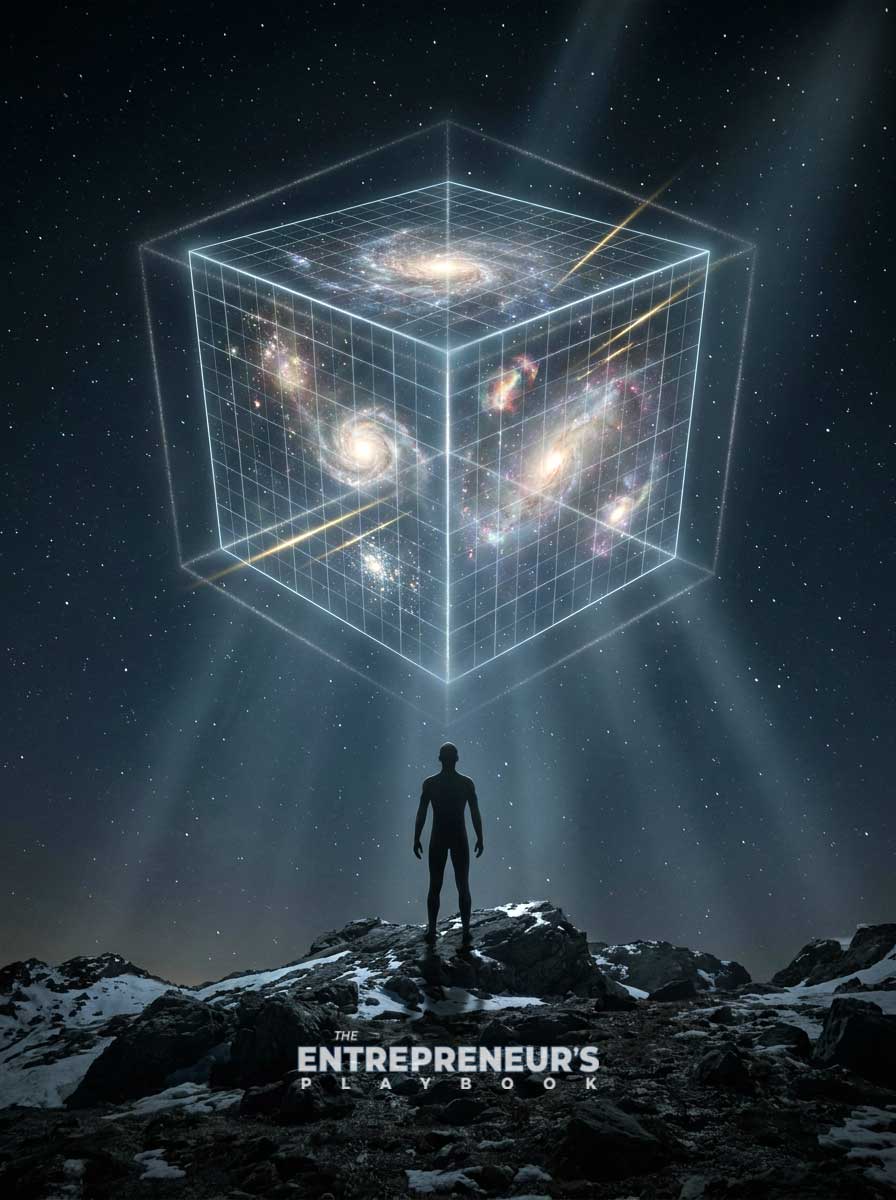
Welcome back to the Entrepreneur’s Playbook series on Life Is a Video Game. In our opening piece, we framed reality itself as the ultimate interactive experience—one where strategy, attention, and intention determine your score. Today we level up: we establish the simulation’s holographic foundation (backed by declassified intelligence) and then calculate its theoretical rendering rate.
We Inhabit a Fully Tactile 3D Hologram
Declassified CIA documents provide one of the most intriguing official nods to this idea. The 1983 report Analysis and Assessment of the Gateway Process (CIA-RDP96-00788R001700210016-5) explores consciousness, out-of-body experiences, and the nature of reality. It draws directly on neuroscientist Karl Pribram’s holographic model of the brain and physicist David Bohm’s implicate order, concluding that the universe behaves like a vast, interconnected hologram (CIA).
In the document’s own words, human consciousness “attunes itself to the universal hologram by the medium of energy exchange.” Reality is not solid matter but a projected field where every fragment contains the whole. This isn’t fringe speculation—it’s a serious intelligence-community analysis of how consciousness interfaces with what appears to be a holographic construct.
Modern simulation theory simply updates the language: the “hologram” is the rendered output of an underlying information substrate. Yet this isn’t a flat projection—it is a fully three-dimensional, touchable hologram. You can reach out and feel the apparent solidity of objects, walk through landscapes, and interact with others as if everything were physically real. Such a seamless, interactive, and tactile 3D construct implies an extraordinarily powerful machine running the show—an engine capable of generating and sustaining this level of fidelity across cosmic scales.
The Rendering Rate = Speed of Light
If the universe is a rendered simulation, what is its frame rate or refresh speed?
Information cannot propagate faster than c—the speed of light (approximately 299,792,458 m/s). This cosmic speed limit is not merely a physical constraint; it is the maximum rate at which the simulation can update causal relationships across space. Any “frame” or rendering tick must respect this boundary, or the illusion of a consistent, shared reality collapses.
In practical terms:
- Light-speed sets the refresh boundary for the entire observable cosmos.
- Planck-scale discreteness (the smallest meaningful units of space and time) further suggests the simulation operates at an extraordinarily high but finite resolution.
- Consciousness, according to the Gateway model, can temporarily step outside these constraints—explaining reports of non-local awareness or altered states.
The rendering rate, therefore, is theoretically the speed of light itself. It is the ultimate clock cycle of the simulation. Every photon, every causal link, every update to your perceived world travels at this maximum speed. Faster would break the game’s internal consistency.
Subtle frequency influences from celestial bodies—such as the Moon and Saturn—may quietly help stabilize and relay the simulation’s signal, keeping the 3D hologram coherent while hinting at deeper dimensional layers (including intersections with the fourth dimension) that lie just beyond current player perception.
Yet the phenomenon of quantum entanglement—where distant particles instantaneously correlate—suggests information can move beyond light-speed limits, revealing a fuller conceptual layer of the simulation we’ll explore in a future article.
Why This Matters for the Player
Recognizing the holographic, light-speed-rendered nature of reality changes how you play:
- Attention is your render priority. What you focus on gets higher resolution in your personal simulation.
- Intention travels at light speed. Clear goals propagate through the field faster when aligned with the system’s rules.
- Limits are features, not bugs. The speed-of-light cap prevents paradoxes and forces elegant, efficient strategies—just like any well-designed game engine.
The simulation is real, the rules are knowable, and the rendering engine runs at the fastest possible rate. Your move.
Play consciously.