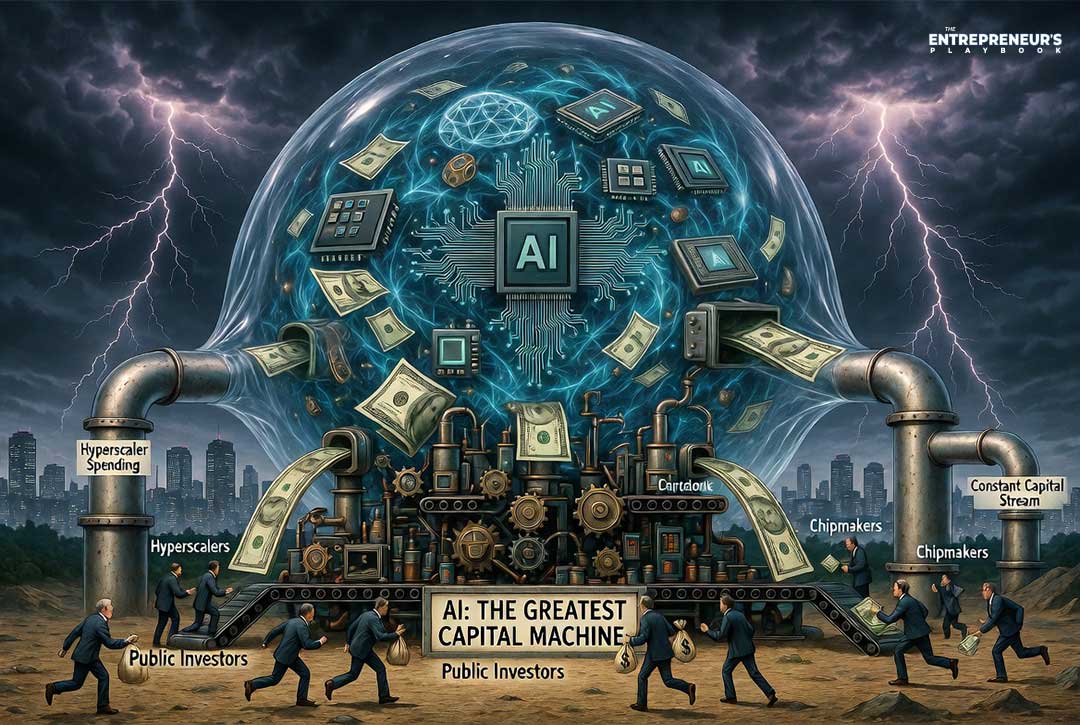
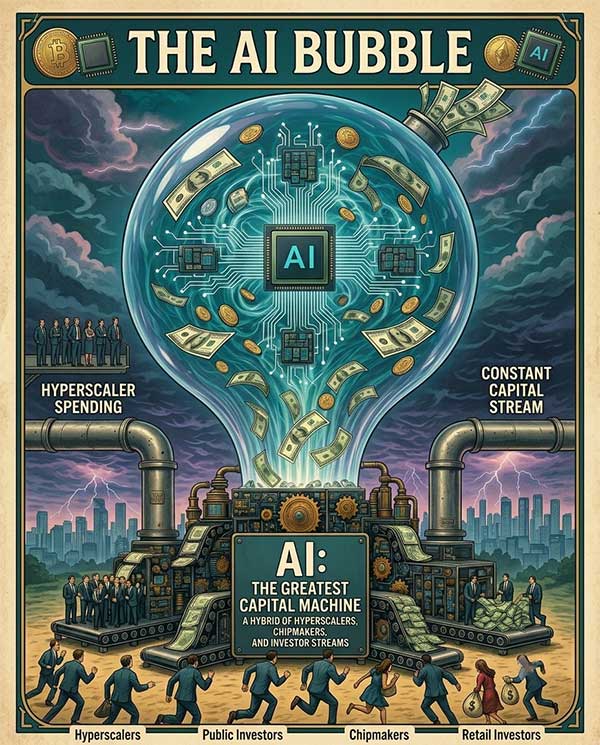
Artificial intelligence is not a mirage. The technology works, the use cases are expanding, and the productivity gains are already measurable. But surrounding this very real innovation is something far less grounded: a rapidly inflating capital cycle that is beginning to resemble a classic market bubble.
What makes this moment unusual is not the existence of hype, but its scale and structure. The AI boom is being financed by an unprecedented flow of capital through a tightly interconnected ecosystem. Hyperscalers are borrowing tens of billions to fund infrastructure buildouts, chipmakers are capturing record revenues, private AI companies are raising at valuations disconnected from near-term cash flow, and public markets are pricing in years of flawless execution. The result is a feedback loop where each layer depends on the next to justify its own valuation.
The numbers tell the story. Major technology companies have already issued roughly $60 billion in bonds to fund AI expansion. Industry-wide capital expenditures are projected to approach $725 billion in 2026, with some estimates pushing total AI-related spending close to $800 billion this year and potentially exceeding $1 trillion by 2027. This is not just investment—it is acceleration at a scale that demands continuous growth to sustain itself.
That is where the distinction matters: AI itself is real, but the financial structure forming around it is increasingly fragile. Today’s valuations are being underwritten by tomorrow’s adoption, and tomorrow’s adoption is being priced as inevitable. When an ecosystem requires ever-larger inflows of capital to validate prior assumptions, it stops behaving like a pure technology cycle and starts to look something else entirely.
The Top 10 Companies at the Center of the AI Capital Stack
These are not simply the “best AI companies.” They are the companies most central to the current AI boom — the infrastructure, distribution, chips, cloud, and model players whose fortunes are tied to the scale of the buildout.
- Nvidia — the tollbooth of the AI boom. If AI companies need GPUs, Nvidia gets paid first.
- Microsoft — the enterprise distribution engine, cloud provider, and key OpenAI partner.
- OpenAI — the symbolic center of the generative AI revolution, reportedly targeting a valuation of up to $1 trillion in a potential public listing.
- Alphabet / Google — owner of Google Cloud, Gemini, DeepMind, and the search business AI is both threatening and extending.
- Amazon / AWS — one of the biggest cloud infrastructure players, using AI to defend and expand its cloud dominance.
- Meta — a massive AI spender with open-source models, ad-scale distribution, and enough cash flow to keep buying compute.
- Anthropic — the enterprise AI safety brand, with its valuation reportedly more than doubling from $380 billion earlier in 2026 as it moved toward an IPO.
- TSMC — the manufacturing choke point behind many of the world’s most important advanced chips.
- Broadcom — a major AI infrastructure beneficiary through networking, custom silicon, and hyperscaler chip demand.
- Oracle — the old enterprise giant reinvented as an AI cloud/data-center infrastructure play.
The honorable mentions matter too: Apple, Palantir, xAI, AMD, Tesla, CoreWeave, and the Chinese AI stack all play roles in the broader trade. But the ten above sit closest to the main financial engine.
Why This Feels Like a Bubble
The bubble is not that people are using AI. The bubble is the assumption that every dollar spent on chips, data centers, power, cooling, networking, talent, and model training will convert into durable, high-margin revenue fast enough to justify the spending.
That is the dangerous part.
A true technology revolution can still create a financial bubble. Railroads were real. The internet was real. Fiber optics were real. Housing was real. The mistake is believing that because the technology matters, every valuation attached to it must also make sense.
The AI economy now has a reflexive loop:
Big Tech spends hundreds of billions on AI infrastructure.
That spending becomes revenue for chipmakers and data-center suppliers.
That revenue validates higher stock prices.
Higher stock prices make investors more confident.
That confidence funds even more AI spending.
And the loop continues.
That is the “Ponzi-like” mechanism. Not because there is one central villain running an illegal scheme, but because the market increasingly requires fresh capital, fresh borrowing, and fresh optimism to justify the last round of spending.
The Coming Problem: AI May Get Cheaper Too Fast
The irony is that AI may become too successful for parts of the bubble to survive.
Reuters reported that companies are already pushing toward cheaper models because usage-based AI costs are overwhelming some corporate budgets. Open-source models and routing platforms are gaining traction as businesses try to avoid expensive frontier-model bills.
That is great for users. It is not automatically great for trillion-dollar valuation stories.
If AI becomes a commodity faster than expected, the winners may be the customers, not the model labs. If businesses can get “good enough” AI for far less money, the premium pricing power of the most expensive models could compress. If model pricing falls, the payback period on massive infrastructure spending becomes harder to defend.
This is where the bubble thesis gets sharper: the market is pricing AI like a scarce miracle, while the technology itself may be racing toward abundance.
Who Profits When the Bubble Cracks?
The public usually enters near the loudest part of the cycle. The insiders, lenders, bankers, hyperscalers, and infrastructure winners often get paid before the narrative breaks.
The companies selling the picks and shovels get paid first. The banks arranging the debt get paid. The private investors with preferred terms get paid. The executives selling stock into strength get paid. The retail investor buying the “future of everything” story often gets left holding the compression.
That does not mean Nvidia, Microsoft, Google, Amazon, or Meta disappear. The strongest companies may survive and dominate the next phase. But a bubble does not require the leaders to fail. It only requires expectations to outrun reality.
And right now, expectations are sprinting.
The Collapse Scenario
The AI bubble does not need one dramatic explosion. It could unwind in stages.
First, enterprises become more disciplined about AI spending.
Then model pricing falls.
Then private AI valuations stop climbing.
Then data-center financing gets tighter.
Then hyperscalers begin slowing capex growth.
Then the market realizes that a large portion of the AI trade was not based on current profits, but on assumed future monetization.
At that point, the same loop that pushed the sector higher can work in reverse.
Less spending means less supplier revenue.
Less revenue growth means lower multiples.
Lower stock prices mean less confidence.
Less confidence means tighter financing.
And tighter financing exposes who was building a business — and who was just riding the capital wave.
The Real Lesson for Entrepreneurs
The takeaway is not to avoid AI—it is to understand where the value actually sits.
AI is a powerful tool, but tools do not create businesses on their own. Durable companies are still built on distribution, pricing power, customer need, and repeatable revenue. Those fundamentals have not changed.
Use AI where it matters: to reduce cost structures, accelerate execution, improve decision-making, and enhance customer experience. But be cautious about building a strategy that depends entirely on being “an AI company” without clear differentiation or control over demand.
The market is currently rewarding exposure to AI. Eventually, it will reward outcomes.
The entrepreneurs who win in that transition will not be the ones most associated with the trend, but the ones who quietly convert it into sustainable economics while others rely on continued capital inflows.
The technology is real. The capital cycle around it is also real. When conditions tighten, the distinction between the two will become impossible to ignore.